You know the feeling.
The cohort finishes. The last call was genuinely good — people said so. For about a week the group is still chatty. Then it slows. Then someone mutes it. Three months later you're starting a new cohort, and you create a new group, and you begin again from zero.
Meanwhile the eighty people who paid you last year are somewhere. You're not sure where. A spreadsheet, probably.
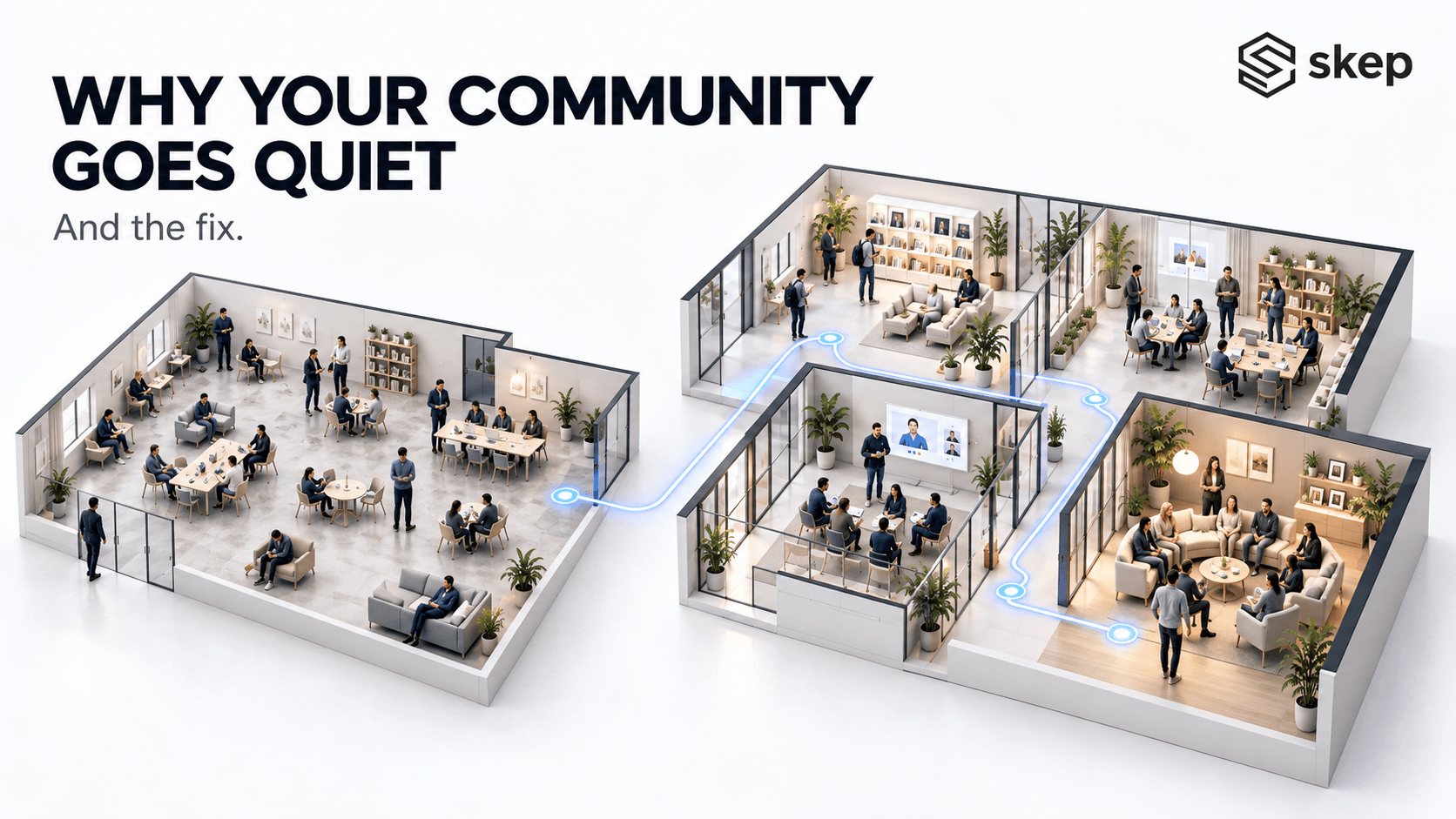
This isn't a content problem or an energy problem. It's a room problem. You're trying to run four different relationships in one space — or in five apps that have never heard of each other.
Here's what to do instead.
You don't have one audience. You have four.
Write them down and it's obvious:
- People who've just found you. Curious. Haven't paid. Reading.
- People who pay you something small and ongoing. Your members.
- People in the middle of your programme right now. Paid properly, need your attention.
- People who've finished. Your best audience, and usually your most neglected.
Each one needs something different from you. The person halfway through week four doesn't want the beginner's question you answer every Tuesday. The newcomer doesn't want to overhear an advanced coaching conversation they can't follow.
And yet most coaches give all four the same room — or worse, a different app each.
What a "room" does
In SKEP, these rooms are called Spaces. A Space is exactly what it sounds like: a place inside your community with its own people in it.
When you set one up, you decide what happens in there. Reading? Discussion? A course? Live calls? A group chat? You switch on what belongs and leave out what doesn't.
So your public room might just have articles and a feed — somewhere to read, nothing to attend. Your cohort room has the course, the weekly calls and its own chat. Your graduates' room has the chat and the monthly call, but no course, because they've finished it.
Same community. Same you. Different rooms for different people.
The part that matters: a person stays one person as they move between them. Someone who reads your free articles, joins your membership, buys a cohort seat and later turns up in your graduates' room is one member with one history — not four disconnected records in four tools. Which means you can finally see that the person who bought your ₹25,000 programme first showed up eleven months ago and read three articles.
That's the idea. What it looks like in practice depends entirely on the shape of your business — so here are three, starting with the one most coaches will recognise.
A coach with four audiences
Take Priya. She coaches leaders, and her setup is probably close to yours: a newsletter list of around 2,000, a ₹999-a-month membership with 80 people in it, a cohort every quarter at ₹25,000 a seat, and three years of graduates she's more or less lost.
What her life looks like now. The cohort runs in a WhatsApp group she rebuilds every quarter. The membership sits on a different tool. Her graduates are a spreadsheet she opens twice a year with a slight feeling of guilt. When a cohort ends, she archives the group — and with it, every conversation and every relationship in it.
What she sets up instead. Four rooms.
The Lounge is open to everyone, including people who've never paid. She publishes her articles here. It's the same writing she was putting on social media, except now it lives somewhere she owns, and the people reading it are already inside her community rather than on somebody else's app.
Members is for her ₹999 crowd. Her whole library of frameworks lives here, searchable. The monthly group call happens here. There's a chat that doesn't need rebuilding or re-inviting — it's just there, and only members are in it.
The Cohort room is where the real work happens. The course with its lessons and quizzes. The weekly live sessions, where everyone's camera is on because these are working sessions, not broadcasts. Its own chat, for this group of people, from day one.
Graduates is the room she never had. When a cohort ends, people move here instead of into an archive. The monthly call gets published to Members and Graduates at the same time — one session, both audiences, no extra work.
What actually changes for her:
Next quarter, she doesn't rebuild anything. She sets up a fresh cohort room, quietly parks the old one, and everything else keeps running.
Her graduates stop evaporating. Three years of people who used to disappear now have somewhere to be — and they're the warmest audience she'll ever pitch to, because they've already paid her once and it worked.
And she never has to argue that the membership is worth ₹999. The rooms show it. Free gets you the Lounge. Paying gets you more. Buying the cohort gets you more again. Nobody has to be convinced of a ladder they can see.
A consultant who can't let clients meet
Arun has the opposite problem to Priya. He consults — two-day workshops for companies, then three months advising the same team, usually with two or three clients on the go.
His worry isn't engagement. It's the opposite — Client A must never see that Client B exists. Right now that's managed by being careful with email and folders, which works until the day it doesn't.
He gives each client its own room, with the course and the live sessions and a place for their reference material — and no shared feed at all, because a corporate team doesn't want one and it's the most likely place for a leak.
Setting up who can see what, he starts from nothing and adds only what that client's team needs. The privacy isn't a promise he's making. It's how the room is built.
His workshop stops being a deck he emails. It becomes a course the team actually works through, with his frameworks sitting alongside it where they're still findable in month three — which, if he's honest, is most of what the client is paying for.
When the engagement ends, he closes the room rather than deleting it. The work is preserved. Access stops.
An academy running three groups at once
The third shape is scale. An analytics bootcamp: four trainers, three batches running in parallel, about forty students in each.
Their problem is duplication. Three batches means three groups, three sets of announcements, and curriculum updated three times. A trainer joining takes a day to set up.
Each batch gets its own room, with the course, the live classes and its own chat. But the curriculum is built once. And each trainer is given access to the batch they teach and nothing else — set once, in one place, rather than negotiated across three apps.
Their free taster sessions run in an open room where prospective students can attend and read, and see nothing else. Graduates from every batch land in one shared careers room — which, for a bootcamp, is where the real long-term value sits. One growing room instead of three dead groups a year.
The room almost everyone forgets
Look again at those three setups. They all have somewhere to buy, and somewhere to learn.
The one that's usually missing is somewhere to be afterwards.
This is the single most common gap, and it's expensive in a quiet way. Your graduates are people who paid you, got a result, and like you. They're the easiest sale you will ever make and the most credible voices you have. And in most businesses they're a spreadsheet.
If you build one room this month, build that one.
Getting it right the first time
Two small habits that save a lot of trouble.
Set the room up before anyone's in it. You can build a room privately — put the course in, check it looks right, then open the doors. Much better than assembling furniture while guests are standing around.
Decide what people can see by starting from nothing. It's tempting to leave the defaults and remove what shouldn't be there. Start the other way round — nothing visible, then add. Then every door that's open is open because you opened it.
Plan yours over a coffee
Twenty minutes with a pen, before you touch anything.
1. Write down the groups of people you serve. Not your products — your people. The public. Your members. The current cohort. Your graduates. Each corporate client. Your own team.
2. Cross out any group smaller than about ten. Fold them into a bigger one. Two half-empty rooms are worse than one busy room.
3. For each group left, ask what they need to do in there. Read? Talk? Learn? Attend? That's what you switch on.
4. For each group, ask what they mustn't see. That's your privacy settings, decided before you open the screen.
5. Circle where a brand-new person should land. That's your front door.
Four or five lines, and you're done. Building it takes minutes after that — and you won't be pulling it apart in six months, which matters, because by then real people and real conversations are living in those rooms.
Try this yourself :
1. Write your list of people before you build anything. Five minutes. This is the step everyone skips and regrets.
2. Build the graduates' room first. Before the fancy course, before the landing page. It's the cheapest room to build and the one earning the most.
3. Set new rooms up privately, then open them. Never assemble a room with people standing in it.
4. Name your rooms after people, not products. "Cohort — January" expires in January. "Graduates" never does.
Your community doesn't go quiet because people stopped caring. It goes quiet because the room they were in was only ever built to last twelve weeks, and nobody built the next one.
Give each group of people a room that belongs to them, and the thing stops being a series of launches that start from zero — and starts being a business that compounds.
Start building it. SKEP is free to begin — no card needed — and everything in this post runs on it. See the plans for coaches and trainers and pick the one that matches where you are today.
© SKEP
The Launchpad for coaches, trainers, consultants & subject matter experts
support@skep.in