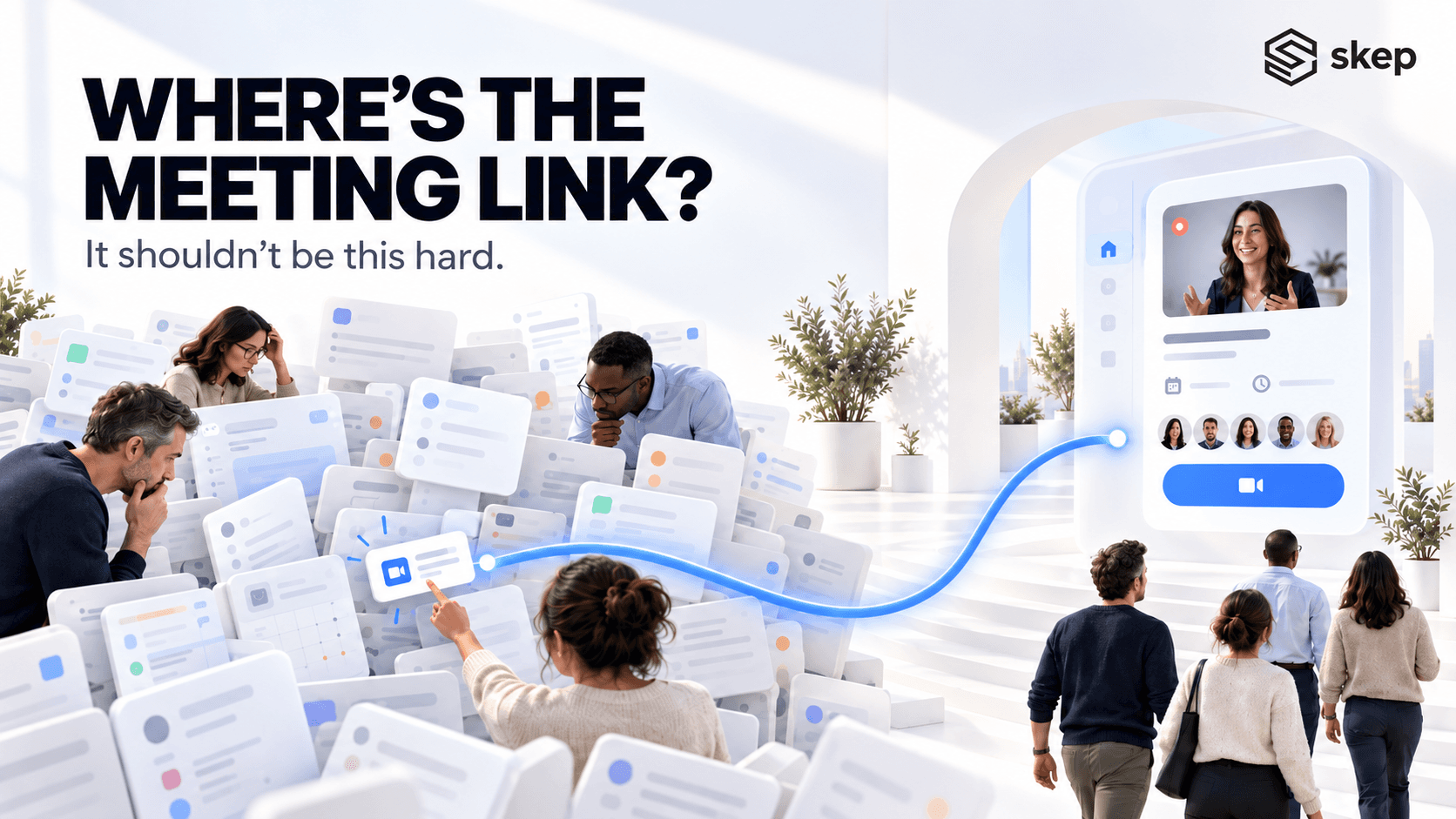
Eight o'clock. The session starts in two minutes and four people are messaging you asking where the link is.
You sent it. Twice. It's in the confirmation email, which is under a promotions tab, and in the group, which is forty messages further up by now. One person is in the waiting room of last month's meeting because they clicked an old link. Another has joined on a phone and can't hear.
By the time everyone's in, you've lost seven minutes and some of the goodwill you needed for the next ninety. This is how live sessions for coaches usually run, and everyone has quietly accepted it.
Then afterwards the recording sits in cloud storage, you paste a link to it somewhere, and you have no real idea who turned up or who watched it later.
None of this is necessary. It happens because the live part of your business lives somewhere completely separate from everything else — and it doesn't have to.
Live sessions for coaches, built in
Live sessions for coaches run better when they're part of the same place as everything else you sell.
In SKEP, live sessions are built in. Not a Zoom account connected to your platform. Not a Google Meet link pasted into a description. The video is part of the platform, which changes several things at once:
- There's no link to find. The session is in the room your members are already in.
- Attendance is attached to the person, not to a separate meeting report you'd have to reconcile.
- The recording lands where the session happened — in the same room, next to the course it belongs to.
- There's no second subscription and no second tool to administer.
That last point is the smallest one. The first is the one that shows up in your attendance numbers.
Three types, and what each is for
Not every live session is the same shape, so there are three.
| 1:1 | Webinar | Cohort | |
|---|---|---|---|
| Who's in it | You and one person | You and an audience | You and a working group |
| They can | Talk freely | Chat, ask questions, vote in polls, react, watch your screen | All of that, plus speak and be seen |
| It feels like | A conversation | A broadcast with participation | A classroom |
| Use it for | Coaching calls, discovery, diagnostics | Filling your funnel, free sessions, launches | Delivering what people paid for |
The difference that matters is who can be seen and heard.
In a webinar, attendees participate but don't appear. That's the right call for a room of two hundred — you don't want two hundred cameras, and nobody expects to be on show when they registered for a free session. They can still ask questions, answer polls and react.
In a cohort session, attendees have video and audio. It's a working session, not a performance. People are meant to talk to each other and be seen doing it, because that's what makes a cohort feel like a cohort rather than a mailing list with a calendar invite.
1:1 is the simplest and the one most coaches spend most of their week in. The useful part isn't the call — it's that the call sits against the same member record as everything else that person has bought, watched and asked.
Getting the type right is most of what separates live sessions for coaches that people attend from ones they skip. Choosing wrongly is a common and expensive mistake. Running your paid cohort as a webinar makes eight people watch you talk when they paid to work with each other. Running a free public session as a cohort call means two hundred people can unmute.
The things you'd otherwise need four tools for
Charge for a session, at two prices. A session can be free, or paid — and you can set one price for the public and another for your members. Members automatically pay less without you issuing a code. That's the mechanism that makes a membership worth paying for rather than something you have to justify.
Let guests in without letting them into everything. Every session has a member link and a separate guest link. A partner's audience can attend your webinar without joining your community or seeing anything else in it.
Decide who can join, and when. Sessions can be open to the public, to your community only, or both — and you can set a registration window so signups close before you start.
Run polls during the session. Live, in the room, not a separate survey tool with its own link.
Cap the room. You set how many people can attend.
Publish one session to several rooms. A monthly Q&A can go to your membership and your graduates at the same time. One session, two audiences, no duplication.
Why this shows up in attendance
Here's the part worth understanding, because it's the commercial argument.
Attendance isn't mostly about interest. It's about friction. Every step between "I intended to come" and "I'm in the room" loses some people — finding the email, finding the link, the link opening the wrong app, the app wanting an update, arriving late and feeling awkward about it.
Take those steps out and the same audience with the same intent attends at a higher rate. Nothing about your content changed.
And attendance is where the money is. A cohort where people actually turn up is a cohort that finishes, gives you testimonials, and sells the next one. A webinar with a full room converts; the same webinar with a third of the registrations present doesn't, no matter how good the offer was.
What this looks like in practice
A coach running all three in one week
A leadership coach's week has all three types in it, and used to have three different set-ups.
Monday and Tuesday are 1:1 calls. Wednesday evening is the cohort session — cameras on, small group, people working through something together. Thursday lunchtime is a free webinar for anyone, which is where next quarter's cohort members come from.
What changed isn't the sessions. It's that all three now happen in the same place as the course, the community and the payments — so the person who attended Thursday's free webinar, joined the membership in March and is sitting in Wednesday's cohort is visibly one person, not three rows in three tools.
The webinar is public and priced at zero. The cohort sessions are members-only. The 1:1s are booked against the same record. Nobody has ever asked for a link.
A consultant delivering a corporate workshop
The consultant's two-day workshop runs as cohort sessions inside that client's private room — attendees seen and heard, because the workshop only works if the team talks.
The guest link matters here. The client's CFO wants to sit in on the second afternoon without being added to anything. One link, one session, no account, no access to anything else.
Recordings stay in that client's room afterwards, alongside the course and the reference material, which is most of what the client refers back to in month three.
An academy running open days and classes
The analytics bootcamp uses the split deliberately.
Free taster sessions are webinars in a public room — two hundred prospective students, cameras off, questions in chat, a poll to gauge who's serious. It's marketing, and it's an honest preview of the teaching.
Actual classes are cohort sessions inside each batch's own room, cameras on, forty students who are expected to participate.
Career mentoring is 1:1. Same platform, same student record, so a mentor can see what that student has actually completed before the call rather than asking.
Two honest limits
Capacity depends on your plan. Participant numbers, session length and how many sessions can run at once all scale with the plan you're on. If you're planning a launch webinar for a thousand people, check the ceiling before you promote it, not after.
Built-in doesn't mean you can skip the basics. Live sessions for coaches still depend on preparation. A bad internet connection is still a bad internet connection. Test your setup, start the room early, and have a fallback plan for the day something goes wrong — because eventually it will, and that's true on any platform.
Try this yourself :
1. Look at your last cohort session and ask which type it should have been. If people paid to work together and spent ninety minutes watching you, that's a webinar pretending to be a cohort.
2. Count the steps between your confirmation email and someone being in the room. Every one of them is costing you attendance.
3. Set a member price on your next paid session. It takes a minute and it's the clearest reason to join your membership that you'll ever offer.
4. Use the guest link for one person who shouldn't have full access. A partner, a prospect, a client's boss. It's the feature people forget exists until they need it.
The live part of your business is the part people remember. It's where they decide whether you're worth the money, whether the group is worth showing up for, and whether they'll buy the next thing.
It shouldn't begin with four people asking where the link is.
Start building it. SKEP is free to begin — no card needed — and everything in this post runs on it. See the plans for coaches and trainers and pick the one that matches where you are today.
© SKEP
The Launchpad for coaches, trainers, consultants & subject matter experts
support@skep.in